
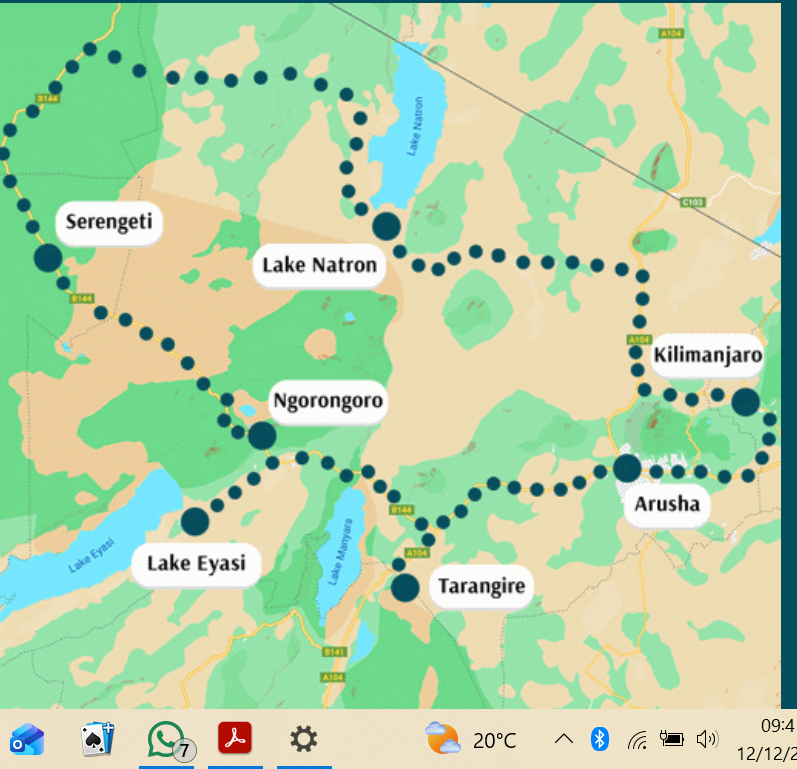
Driving Distances and Times in Tanzania
The most common mistake on a first self-drive in Tanzania is planning with the times a navigation app gives you. On the tarmac between…
 Self DriveTanzania
Try “rooftop tent”, “Serengeti”, “park fees” or “one-way”.

Driving in Tanzania is easier than many visitors expect. The main routes of the northern circuit are tarmac, signposts are in English, and outside the cities traffic is light. What catches people out is not the roads but the rules: frequent police checks, strict speed limits in every village, and park regulations that differ from the open road. This guide covers what you need to know before you collect your car.
| Where | Limit | Notes |
|---|---|---|
| Towns, villages and built-up areas | 50 km/h | Signed at the village entrance; often 30–40 km/h near schools and markets |
| Open main roads | As signed, usually 80 km/h | Some stretches 100 km/h; limits change often, so watch the signs |
| National park roads | 50 km/h maximum | Lower on game tracks and where signed |
| Ngorongoro Crater floor and descent roads | Low, as signed | Steep, one-way descent and ascent roads; use low range |
Speed is checked with hand-held radar guns, often just after a village sign where the limit drops from 80 to 50 km/h. The simplest way to avoid fines is to slow down as soon as you see the first houses, and stay slow until you see the end-of-limit sign. Speed bumps, some of them unmarked, are common at village entrances.
Traffic police in white uniforms stand at many village entrances and junctions, especially on the Arusha–Moshi road, the road to Karatu and the Dar es Salaam highway. Being waved over is routine and usually friendly.
For most minor offences, such as speeding or a missing triangle, the police issue a standard notification fine of TSh 30,000 per offence. Fines are recorded electronically: the officer gives you a control number and you pay it by mobile money or at a bank, and the payment produces an official receipt. Always ask for the control number or an official receipt for any payment.
Never hand cash to anyone without one, and call us if you are asked to pay in a way that does not feel right.
Fines are the driver’s responsibility under our rental terms. If a fine is linked to the car’s registration after you have returned it, we pass it on with the receipt.
In case of a breakdown, pull as far off the road as you can, put out both warning triangles well behind the car, and call us. We talk you through simple fixes by phone and, where needed, send a mechanic or a replacement vehicle. After any accident, call the police and us before moving the vehicle if it is safe to leave it, take photos, and do not sign anything you do not understand.
Our phone and WhatsApp number, +255 684 031 321, is on your rental agreement and on a sticker in the car.
Ask our team in Arusha. We usually reply the same day.
Send your dates and route. We reply with vehicle options and a full price, usually the same day.
The most common mistake on a first self-drive in Tanzania is planning with the times a navigation app gives you. On the tarmac between…
Road conditions in Northern and Southern Tanzania By African standards, the road conditions of Northern Tanzania are great. The primary roads that connect Arusha…
A self-drive adventure through the wilderness of Tanzania is one that you should not think of missing out. Imagine driving yourself through all the…

